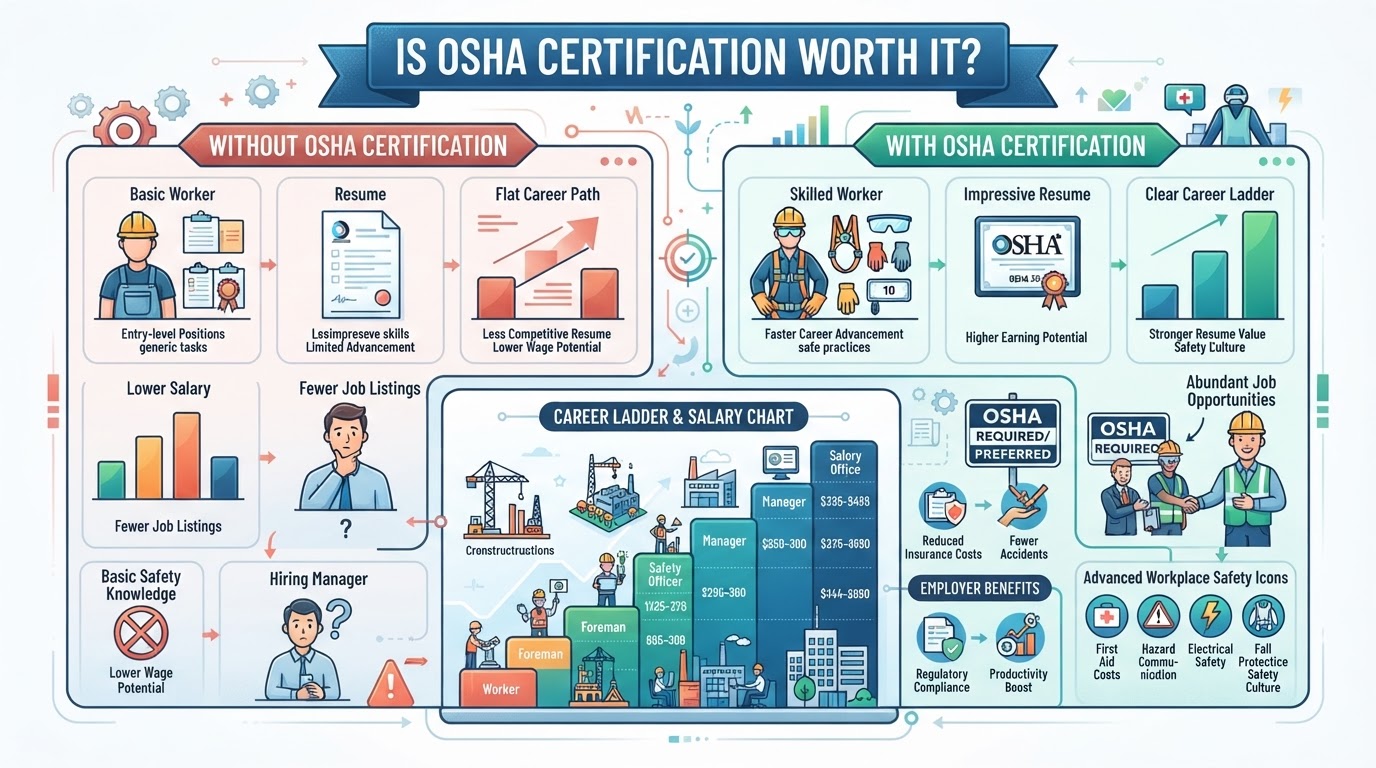
This is one of the most consistently asked questions about OSHA training — worth it, better for a resume, does it actually help pay or job prospects. Here's a direct, honest answer rather than a generic "yes, always."
Jump To:
The Short Answer
For most people working in or entering construction, yes — OSHA 10 is close to a baseline expectation on many job sites, and OSHA 30 frequently opens doors that OSHA 10 alone doesn't. But the value isn't identical for everyone, and it's worth understanding why before assuming it applies to your specific situation.
Both courses are part of the OSHA Outreach Training Program — a voluntary federal program, not a mandatory one, which is part of why "worth it" depends on your specific job site or career goals rather than being a universal yes.
Why OSHA 10 Is Often Worth It
- It's frequently a job-site requirement, not just a nice-to-have. Many general contractors won't allow workers on site without it, meaning OSHA 10 can be the difference between being eligible for a job and not.
- It signals baseline safety awareness to employers. For entry-level workers with limited experience, OSHA 10 is a concrete, verifiable credential that demonstrates some safety knowledge before day one.
- It's a relatively low time and cost investment. At 10 hours and $350, it's a modest commitment relative to the doors it can open.
Why OSHA 30 Often Has More Career Impact
OSHA 30 tends to matter more for career advancement specifically because it's associated with supervisory and safety-management responsibility:
- It's frequently required for foreman, supervisor, or safety lead roles. Without it, those opportunities may not be available to you regardless of your experience.
- Some jurisdictions require it for licensing. Philadelphia, for example, requires licensed construction contractors to have at least one supervisor with OSHA 30 completed within the last 5 years.
- It signals readiness for more responsibility. The 30 hour curriculum covers safety program management, not just individual hazard awareness.
Confirm before publishing: does SafeCru have any data, testimonials, or examples of students who moved into supervisory roles after OSHA 30? Real examples would strengthen this section considerably.
Does OSHA Certification Actually Increase Pay?
This is harder to answer with a universal number, and it's worth being honest about that rather than citing an inflated statistic. What's true directionally:
- Supervisory and safety management roles that typically require OSHA 30 tend to pay more than entry level positions that only require OSHA 10. However, that difference comes from the role itself, not the certification alone.
- OSHA 30 can be a prerequisite for being considered for higher paying roles. This creates a real, though indirect, impact on earning potential.
- Neither certification guarantees a raise on its own. The value comes from expanding the jobs you are qualified and eligible to pursue, not from an automatic pay increase.
When OSHA Certification Matters Less
To be balanced: if you're not working in construction or a related field, OSHA 10/30 has limited relevance — it's industry-specific credentialing, not a general-purpose resume booster. And if a specific job site or employer doesn't require it, holding the certification without a role that uses it won't independently change your job prospects.
Do You Need Both OSHA 10 and OSHA 30?
No. They're separate courses for different roles, not sequential levels of the same credential. A supervisor can hold OSHA 30 without ever having completed OSHA 10 separately. Which one (or both) you need depends entirely on your role and what your employer or job site requires.
For the full breakdown of what each course covers, see SafeCru's Complete Guide to OSHA Training.
Frequently Asked Questions
Is OSHA 10 worth it for an entry-level construction worker?
Generally yes — it’s frequently required just to get on a job site, and it’s a relatively low-cost, low-time investment.
Is OSHA 30 worth it if I'm not currently a supervisor?
It can be, if you’re aiming for a supervisory or safety-lead role — many of those positions specifically require OSHA 30, so holding it in advance can make you eligible for roles you otherwise wouldn’t be considered for.
Does OSHA certification guarantee a pay raise?
No — the pay impact comes from being eligible for higher-paying roles that require the certification, not from the certification itself automatically increasing pay.
Does OSHA 10 or OSHA 30 look good on a resume?
For construction-related roles, yes — it’s a concrete, verifiable credential. For unrelated fields, it has limited resume value.
Can you get a job with just OSHA 30, without OSHA 10?
Yes — OSHA 30 doesn’t require OSHA 10 as a prerequisite, and many supervisors hold only OSHA 30.