The Complete Guide to Scaffold Certification Training
Scaffold User Certification in Indianapolis — Bilingual, In-Person Training
If your work puts you on or around scaffolding, OSHA requires training before you’re on the platform — not after. This guide covers what scaffold certification actually requires, the real OSHA regulations behind it, what SafeCru’s courses cost, and what to expect from bilingual, Indianapolis-based training.
Jump to
What Is Scaffold CertificationOSHA Scaffold Requirements ExplainedWhich Course You NeedCost & Course DetailsIs It Worth It
Quick Facts
| Scaffold Training Quick Facts | |
|---|---|
| Courses offered | Scaffold User 8-hr, OSHA 10 + Scaffold User combo |
| Language | English & Spanish |
| Location | Indianapolis, IN |
| Format | In-person, instructor-led |
| Weekend Classes | Available on request (spans multiple weekends depending on course length) |
| Prerequisites | None |
| Certification Validity | No expiration |
What Is Scaffold Certification?
Scaffold-related falls and collapses are a significant, ongoing cause of construction injuries and fatalities — OSHA’s scaffolding standard, 29 CFR 1926 Subpart L, consistently ranks among the agency’s most frequently cited standards. Scaffold User training exists to make sure anyone working on or around scaffolding understands the hazards, the equipment, and the procedures that keep a job site safe.
Did You Know?
OSHA doesn’t just require scaffolds to be built correctly — it specifically requires that employees be trained to recognize scaffold-related hazards, under 29 CFR 1926.454. Training isn’t optional paperwork; it’s a distinct regulatory requirement separate from the construction standards themselves.
OSHA Scaffold Requirements Explained
Scaffold regulation comes with a handful of specific technical rules that show up constantly in searches — and get misquoted just as often. Here’s what’s actually in the standard.
Key OSHA Scaffold Numbers
4:1
Height-to-base ratio before restraint required
10 ft
Fall protection required above this height
Each Shift
Competent person must inspect — not weekly
4x
Load capacity scaffolds must support
Source: OSHA 29 CFR 1926.451 & 1926.454
Key OSHA scaffold numbers: 4:1 height-to-base ratio, 10 feet fall protection, inspection each shift, 4x load capacity
The 4:1 Rule (Often Misquoted as “3:1”)
Under 29 CFR 1926.451(c)(1), a supported scaffold with a height-to-base-width ratio of more than 4 to 1 must be restrained from tipping — by guying, tying, bracing, or an equivalent method. In practice: measure the narrowest side of the scaffold’s base, multiply by four, and that’s the maximum height before the scaffold needs to be secured. A scaffold with a 5-foot-wide base can stand 20 feet tall unrestrained; taller than that, it needs bracing.
You’ll sometimes see this referred to as the “3:1 rule” in searches — that’s a common misstatement. There’s no separate official 3:1 standard; it’s the same 4:1 rule, just misremembered.
The 10-Foot Fall Protection Rule
Each employee on a scaffold more than 10 feet above a lower level must be protected from falls by guardrails, a personal fall arrest system, or both. This is a higher threshold than general construction’s more commonly known 6-foot fall protection trigger — the scaffold-specific standard controls once you’re working on scaffolding, not the general rule.
Inspection Requirements (Not “Every 7 Days”)
A common search asks whether scaffolding must be inspected every 7 days — it doesn’t. The actual requirement is that a competent person must inspect scaffolds and scaffold components before each work shift, and again after any event that could affect structural integrity (wind, impact, rain). That’s a per-shift standard, not a weekly one.
The Two Basic Types of Scaffolds
OSHA’s standard categorizes scaffolds into two basic types:
Supported scaffolds
platforms resting on rigid load-bearing members like poles, legs, or frames (the most common type on construction sites)
Suspended scaffolds
platforms hung by ropes or other non-rigid means from an overhead structure
Most specific scaffold configurations you’ll encounter — frame scaffolds, tube-and-coupler systems, single- and two-point suspension scaffolds — fall under one of these two categories.
Which Scaffold Course Do You Need?
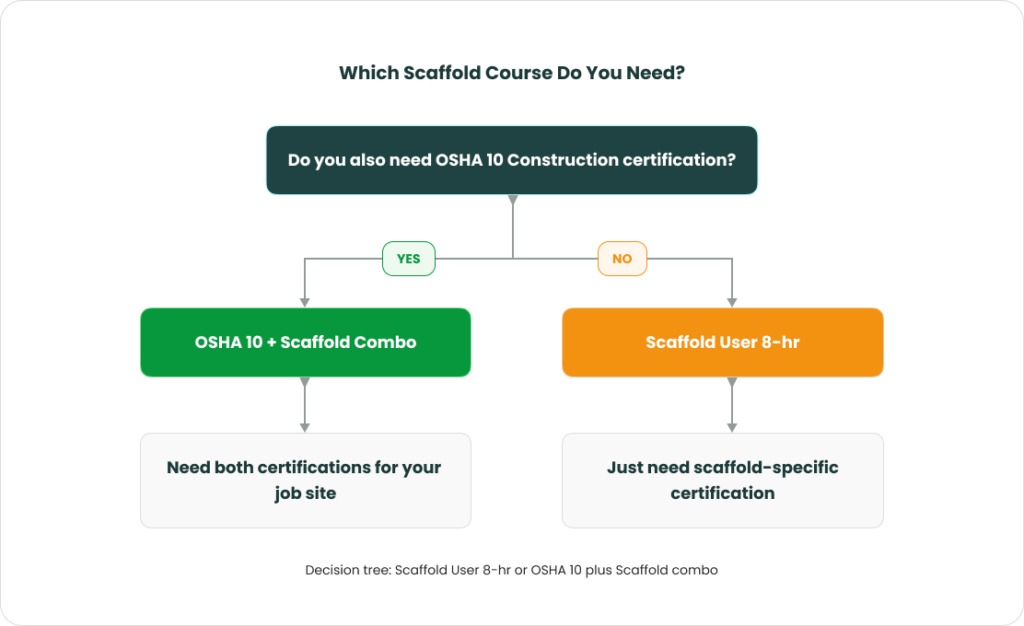
- You just need Scaffold User certification → Scaffold User 8-hr
- You also need OSHA 10 Construction certification → OSHA 10 + Scaffold User combo — both certifications in one course at a bundled price
If you’re not sure which your employer or job site requires, the combo course is the safer default for anyone who needs general OSHA construction certification alongside scaffold-specific training.
SafeCru’s Scaffold Course Catalog
| Course | Price | Length |
|---|---|---|
| Scaffold User 8-hr | $250 | 1 day (8 hours) |
| OSHA 10 in Construction + Scaffold User combo | $350 | 2 days (10 hours total) |
Both courses are taught in person in Indianapolis, available bilingually in English and Spanish. Weekend scheduling is available on request — reach out if a weekend session isn’t currently on the calendar; weekend classes span multiple weekends depending on course length.
What Scaffold User Training Covers
SafeCru’s Scaffold User course provides a comprehensive understanding of scaffolding principles, safety practices, and the practical skills required for working with scaffolding systems. The curriculum covers:
- Different types of scaffolding systems
- Safety protocols and PPE requirements
- Practical techniques for erecting and dismantling scaffold structures
- Proper inspection procedures
- Regulatory compliance
By the end of the course, participants have the knowledge and skills to contribute to safe and efficient scaffolding operations on a construction project.
Is Scaffold Certification Worth It?
For anyone working on or around scaffolding, this isn’t really optional — OSHA requires the training, and job sites generally won’t allow uncertified workers on scaffolding. Beyond compliance, scaffold-specific training addresses hazards (tipping, fall protection, structural integrity) that are directly responsible for a significant share of construction injuries and fatalities.
For a broader look at scaffold work as a career path, see Is Scaffolding Worth It? Career & Value Explained.
In-Person Training
SafeCru’s scaffold courses are taught in person in Indianapolis — hands-on practice with erecting, inspecting, and working safely on scaffolding is part of the curriculum, not something that translates well to video-only instruction
For more on SafeCru’s in-person approach, see In-Person OSHA Training: Why SafeCru Teaches It This Way, which applies to scaffold training as well
Does Scaffold Certification Expire?
No — SafeCru’s Scaffold User certification has no expiration date. Unlike some other certifications that require periodic refresher training, once you complete the course, that certification doesn’t lapse on a fixed schedule.
Common Scaffold Violations
Scaffolding (29 CFR 1926.451) is consistently one of OSHA’s most frequently cited standards in construction. Common violation categories include missing or inadequate fall protection, improper platform construction (planking, access points), scaffolds not rated for at least 4 times their maximum intended load, and missing guardrails on platforms more than 10 feet up. Proper training directly addresses recognizing these issues before they become citations — or injuries.
Bilingual Instruction
SafeCru’s scaffold courses are taught in both English and Spanish, with dedicated bilingual instructors and materials — the same standard applied across SafeCru’s full course catalog.
Group & Employer Training
SafeCru supports registering multiple students together under one company contact — useful for employers certifying a crew before a project starts rather than staggering individual enrollments.
Why Choose SafeCru
SafeCru offers both standalone Scaffold User certification and the combined OSHA 10 + Scaffold bundle, taught in person and bilingually in Indianapolis, with weekend scheduling available on request.
Frequently Asked Questions
Does OSHA require scaffold training?
Yes — under 29 CFR 1926.454, employers must train employees who work on scaffolds to recognize scaffoldrelated hazards.
How much does scaffold certification cost?
$250 for the standalone Scaffold User course, or $350 for the combined OSHA 10 + Scaffold User course.
How long does scaffold certification training take?
8 hours (1 day) for the standalone Scaffold User course.
Does scaffold certification expire?
No — SafeCru’s Scaffold User certification has no expiration date.
What is the 4:1 rule for scaffolding?
A supported scaffold taller than 4 times its base width must be restrained from tipping by guying, tying, or bracing. It’s sometimes mistakenly called the “3:1 rule.”
At what height is fall protection required on a scaffold?
Above 10 feet — higher than the general construction 6-foot fall protection trigger.
Does scaffolding have to be inspected every 7 days?
No — the actual requirement is inspection by a competent person before each work shift, and after any event that could affect structural integrity.
Is scaffold training available online?
SafeCru’s scaffold courses are taught in person in Indianapolis.
Is scaffold training offered in Spanish?
Yes — SafeCru’s scaffold courses are available in both English and Spanish
Can I get OSHA 10 and scaffold certification together?
Yes — SafeCru’s OSHA 10 + Scaffold User combo course covers both in one 2-day session.
Can our company register a group for scaffold training?
Yes — SafeCru supports registering multiple students under one company contact.