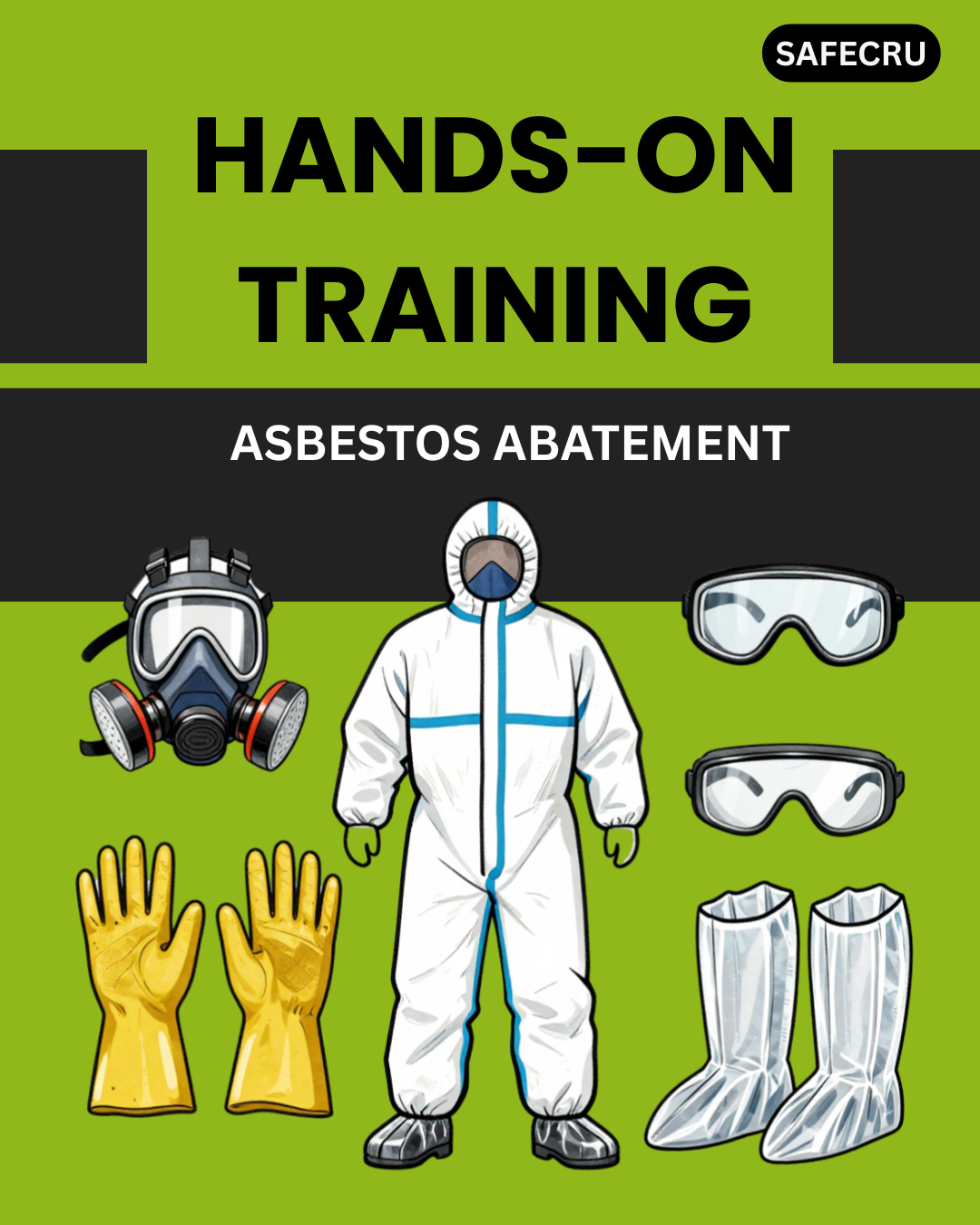
Asbestos Worker and Supervisor certification aren't just about passing a test — they're about being able to safely perform procedures that carry real physical risk if done wrong. Here's why the hands-on component of this training isn't optional in any meaningful sense, even when a provider treats it that way.
Jump To:
What "Hands-On" Actually Covers
For asbestos Worker and Supervisor certification, hands-on training means physically practicing the procedures the job actually requires:
- Donning and doffing PPE and respirators correctly, including fit
- Building and working within containment, including poly sheeting and negative air pressure setups
- Glove bag procedures for pipe insulation removal
- Wet methods, including properly wetting ACM before and during removal to control fiber release
- Decontamination, including moving through a decon line in the correct sequence
- Waste bagging, labeling, and disposal procedures
These are physical, sequential skills. Reading about the correct order of a decontamination line is different from actually walking through it under an instructor's supervision.
Why This Matters More for Abatement Than for Awareness Training
Awareness-level training teaches recognition — knowing what asbestos-containing material looks like and understanding not to disturb it. That's genuinely knowledge-based content, and classroom instruction covers it well.
Worker and Supervisor certification is different. These certifications prepare people to actually remove ACM (Worker) or oversee its removal (Supervisor). This work is governed by OSHA's construction standard, which classifies asbestos work into four risk based classes, with the highest risk Class I and II work carrying the most stringent training and control requirements. This type of standard assumes trained personnel can execute procedures correctly, not just describe them.
What Gets Lost Without Real Practice
- Correct sequence under pressure. Decontamination and containment procedures have to happen in the right order every time. That's muscle memory, not trivia.
- PPE confidence. The first time using a respirator or full containment suit shouldn't be on an active abatement site.
- Instructor correction in real time. A live instructor can catch a mistake in glove bag technique before it becomes a habit. A video can't.
- Realistic conditions. Practice with actual materials and equipment instead of only watching someone else perform the work.
What SafeCru's Courses Include
SafeCru's Asbestos Worker Initial and Supervisor Initial courses include extensive hands-on exercises as part of the curriculum, taught in person in Indianapolis. A respirator fit test is available for an additional charge for students who need one. This follows EPA's Model Curriculum for asbestos worker and supervisor training, which is built around in-person, hands-on instruction for these certification levels.
Curious how this compares to online only options? See In-Person vs. Online Asbestos Training.
Questions to Ask Any Provider
- How much of the course is hands on versus classroom lecture?
- Will I practice with real PPE, containment materials, and equipment, or only watch a demonstration?
- Is an instructor present during hands on practice to correct technique in real time?
If a provider can't answer these clearly, that's worth treating as a red flag before you enroll.
Frequently Asked Questions
Is hands-on training required for asbestos Worker certification?
Worker and Supervisor-level asbestos training is built around EPA’s Model Curriculum, which includes hands-on components — providers vary in how seriously they deliver this, so it’s worth confirming directly.
Do I need hands-on training for Awareness-level certification?
No — Awareness training focuses on recognition and hazard understanding, not hands-on abatement procedures, since Awareness-certified workers aren’t authorized to disturb asbestos-containing material.
Can hands-on asbestos training be done virtually?
Not meaningfully. Procedures like glove bag removal, containment setup, and decontamination require real practice with real equipment — video demonstration can show the steps, but it can’t correct your technique or build the physical familiarity the training is meant to produce.