The Complete Guide to Asbestos Certification in Indiana (2026)
Table of Contents
Executive Summary
If you're wondering how much asbestos certification costs in Indiana, the short answer is between approximately $100 and $750, depending on the type of certification required. Entry-level Asbestos Awareness training typically starts around $100, Worker Initial certification runs about $625, and Supervisor Initial certification is approximately $750. Annual refresher courses generally range from $245 to $350
But cost is only one piece of the puzzle. Choosing the wrong certification can delay projects, create compliance issues, increase liability, and even prevent workers from legally performing certain asbestosrelated work. The right certification depends on your job responsibilities, the type of work being performed, and whether you'll be working near, disturbing, or removing asbestos-containing materials (ACM).
Indiana asbestos training sits at the intersection of federal EPA regulations, OSHA worker safety requirements, and Indiana Department of Environmental Management (IDEM) licensing and exam requirements. A common and costly misconception is that OSHA training alone qualifies someone to perform asbestos work — in reality, regulated abatement work typically requires EPA-accredited training plus compliance with Indiana's state-specific requirements.
This guide is for:
- Contractors bidding a renovation project
- Environmental companies hiring new technicians
- Facility managers responsible for employee safety
- Maintenance workers and demolition contractors
- Anyone starting a career in asbestos abatement
By the end, you'll understand what each certification costs, which one applies to your role, how Awareness, O&M, Worker, and Supervisor training differ, Indiana's licensing and IDEM requirements, renewal timelines, common mistakes to avoid, and answers to the questions we hear most often.
Indiana Asbestos Certification Costs
A quick comparison of current SafeCru course starting prices.
Awareness
- Starting price: $100
- Typical length: 2 hours
Worker Initial
- Starting price: $625
- Hands-on abatement role
Supervisor Initial
- Starting price: $750
- Project oversight role
O&M Courses
- 245–400
- Maintenance-focused
Refreshers
- 245–350
- Match existing discipline
Exam Review
- Starting price: $45
- IDEM exam preparation
SafeCru Safety Resource Center
Indiana Asbestos Certification Costs
How Much Does Asbestos Certification Cost in Indiana?
Certification
Typical Cost
Asbestos Awareness (2-Hour)
$100
O&M Initial
$400
O&M Refresher
$245
Worker Initial
$625
Worker Refresher
$350
Supervisor Initial
$750
Supervisor Refresher
$350
IDEM Exam Review
$45
Certification
Asbestos Awareness (2-Hour)
Certification
O&M Initial
Certification
O&M Refresher
Certification
Worker Initial
Certification
Worker Refresher
Certification
Supervisor Initial
Certification
Supervisor Refresher
Certification
Supervisor Refresher
Certification
IDEM Exam Review
Prices may change over time — always verify current pricing before registering.
The least expensive course isn't always the correct one. The training you need depends on your specific job duties, and enrolling in the wrong course can mean repeating training before you're legally qualified to perform regulated asbestos work.
Why Asbestos Certification Matters
Asbestos training isn't just another safety class. It exists because asbestos exposure remains one of the most heavily regulated occupational hazards in the United States. While asbestos-containing products are no longer installed in new construction, millions of square feet of legacy ACM remain in Indiana's schools, hospitals, factories, power plants, commercial buildings, and apartment complexes.
When these materials are disturbed during renovation, demolition, maintenance, or repair, microscopic asbestos fibers can become airborne — invisible to the naked eye and capable of remaining in the lungs for decades. Long-term exposure is linked to serious disease, including asbestosis, lung cancer, mesothelioma, pleural plaques, and other chronic respiratory conditions. Because symptoms often don't appear for decades, proper training is one of the most effective tools for preventing occupational illness.
For employers, certification goes beyond regulatory box-checking. Properly trained workers are more likely to recognize ACM before disturbing it, follow correct containment procedures, use appropriate PPE, understand decontamination protocols, and avoid accidental fiber release — protecting building occupants, preventing costly shutdowns, and avoiding violations.
For contractors, training is also a business asset. Many commercial clients, government agencies, schools, and healthcare systems require proof of proper certification before work begins. Without it, contractors risk losing bids, failing audits, or facing project delays.
Why Does Indiana Have Different Levels of Asbestos Certification?
A common misconception is that there's a single "asbestos certification." There isn't — Indiana recognizes multiple certification categories because workers perform very different types of work with very different exposure risks.
A janitor changing ceiling tiles in an older school faces a different risk profile than a licensed abatement technician removing pipe insulation in an industrial boiler room. Likewise, the supervisor managing an abatement project carries significantly greater legal and regulatory responsibility than an entry-level technician working under direct supervision.
Rather than one-size-fits-all training, certification is divided by job responsibility:
- Awareness training teaches workers to recognize asbestos hazards without disturbing ACM.
- Operations & Maintenance (O&M) training prepares maintenance personnel to safely perform limited work that may disturb small quantities of asbestos.
- Worker Initial certification prepares technicians to perform regulated asbestos removal and abatement.
- Supervisor Initial certification prepares project leaders to oversee abatement activities while ensuring compliance and worker safety
Knowing which category applies to your role is the first — and most important — step before registering for any course.
Which Asbestos Training Do I Need?
The answer depends entirely on what work you'll actually be performing. Many people assume they need the highest-level certification available; others take a course that doesn't qualify them for the work they're expected to do. Both mistakes cost time and money.
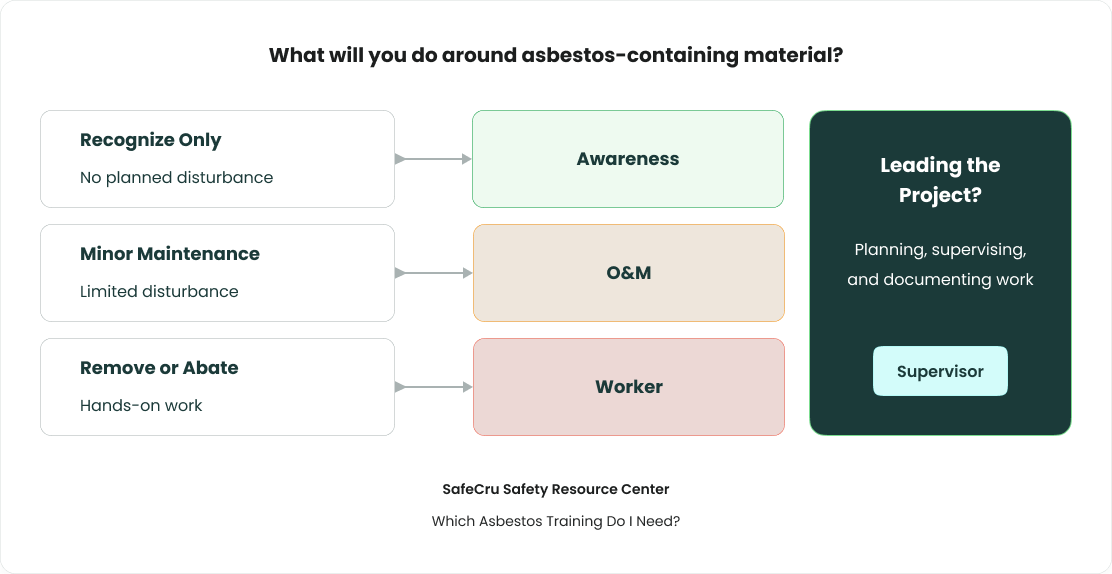
Before registering for any course, ask yourself:
1. Will I simply be working in a building that contains asbestos?
2. Will I be disturbing asbestos-containing materials (ACM)?
3. Will I be removing or repairing ACM?
4. Will I be supervising asbestos abatement projects?
If you only need to recognize asbestos hazards → Asbestos Awareness
Designed for workers who may encounter ACM during normal job duties but won't intentionally disturb it — building maintenance staff, custodians, property managers, HVAC technicians, electricians, plumbers, general contractors, and facility engineers. Awareness training covers what asbestos looks like, where it's commonly found, health hazards, emergency procedures, and how to avoid disturbing ACM. Workers who complete Awareness training are not authorized to perform asbestos abatement.
View the Asbestos Awareness courseIf you perform maintenance that could disturb small amounts of asbestos → Operations & Maintenance (O&M)
Intended for maintenance personnel who may disturb small quantities of ACM during routine work — drilling through asbestos-containing wall material, minor ceiling repairs, small pipe repairs, equipment maintenance, or limited floor tile replacement. O&M goes beyond Awareness by teaching engineering controls, containment methods, PPE, respiratory protection, waste handling, and cleanup procedures. Universities, hospitals, school corporations, manufacturing facilities, and government buildings commonly require it.
View the Asbestos O&M courseIf you'll supervise asbestos projects → Supervisor Initial
Supervisors carry considerably more responsibility than workers — project planning, worker safety, regulatory compliance, documentation, daily oversight, air monitoring coordination, client communication, and inspection readiness. Supervisor training includes everything in Worker Initial plus project management, exposure assessment, employee supervision, quality assurance, recordkeeping, and incident management. Supervisors are often the face of the project for clients and regulators alike.
View the Asbestos Supervisor Initial courseIf you'll actually remove asbestos → Asbestos Worker Initial
Required for personnel performing regulated abatement — pipe or boiler insulation removal, floor tile removal, ceiling texture removal, fireproofing removal, mechanical insulation removal, or demolition involving regulated ACM. Worker Initial is significantly more comprehensive than Awareness or O&M, covering OSHA's construction asbestos standard (29 CFR 1926.1101) and general industry standard (29 CFR 1910.1001), EPA accreditation requirements under 40 CFR Part 763, Indiana-specific requirements, respiratory protection, containment construction, glove bag procedures, decontamination, air monitoring, waste disposal, and emergency response. OSHA's construction standard sets a permissible exposure limit (PEL) of 0.1 fiber per cubic centimeter of air as an 8-hour time-weighted average, with a 1.0 fiber/cc excursion limit over any 30 minutes.
View the Asbestos Worker Initial courseAsbestos Training Comparison
Awareness, O&M, Worker, and Supervisor training serve different job functions.
Training
Primary Purpose
Typical User
Renewal
Awareness
Recognize hazards
Staff working nearby
No fixed cycle
O&M
Limited maintenance work
Maintenance personnel
Annual refresher
Worker
Hands-on abatement
Removal crew
Annual refresher
Supervisor
Oversee abatement
Project leads
Annual refresher
Training
Awareness
Training
O&M
Training
Worker
Training
Supervisor
SafeCru Safety Resource Center
Asbestos Training Comparison
Certification
Typical Worker
Can Disturb ACM?
Can Remove ACM?
Supervisory Responsibilities
Awareness
Maintenance, custodial, contractors
No
No
No
O&M
Maintenance personnel
Limited
No
No
Worker
Abatement technicians
Yes
Yes
No
Supervisor
Project supervisors
Yes
Oversees removal
Yes
Certification
Awareness
Certification
O&M
Certification
Worker
Certification
Supervisor
Real-World Examples
School maintenance employee
occasionally replaces ceiling tiles and performs minor repairs, may encounter ACM. Recommended: Awareness, or O&M if the work could actually disturb ACM.
Hospital facility manager
in-house maintenance team occasionally repairs around asbestoscontaining pipe insulation. Recommended: O&M.
Commercial demolition contractor
removing interior walls in a 1965 office building where a survey identifies regulated ACM. Workers removing the material need Worker Initial; the project supervisor needs Supervisor Initial.
Environmental contractor
specializing in abatement — field employees need Worker Initial; crew leaders need Supervisor Initial.
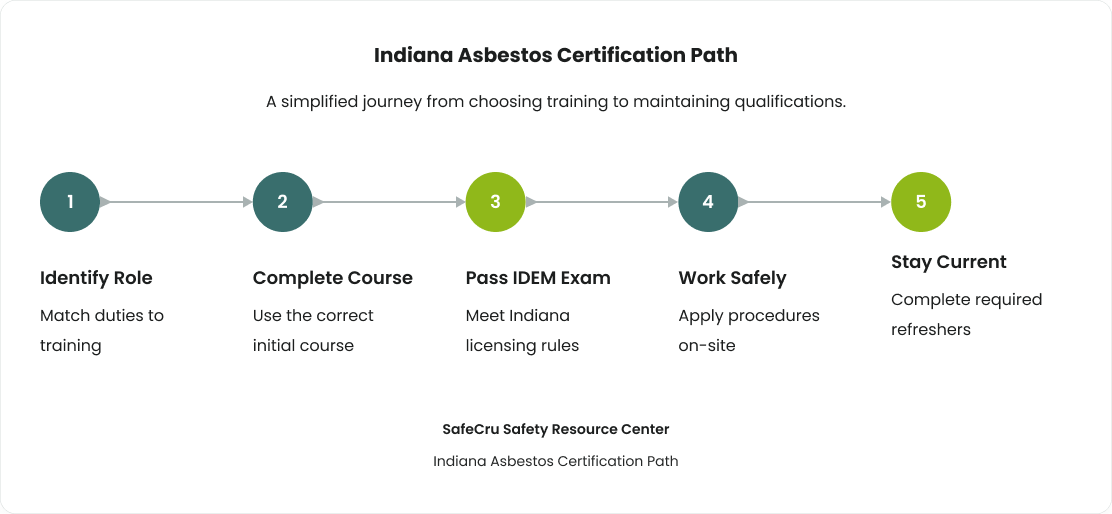
What's the Difference Between an Asbestos Worker and an Asbestos Supervisor?
Many people assume Supervisor certification means "more training." In reality, the role changes completely.
A Worker focuses on safe removal, PPE, containment, cleanup, and following procedures. A Supervisor focuses on planning, compliance, documentation, crew leadership, client interaction, regulatory inspections, and daily project oversight. Put simply: workers perform the work; supervisors ensure the work is performed safely, legally, and according to project specifications.
Who Regulates Asbestos Work in Indiana — EPA, IDEM, or OSHA?
This is one of the most common points of confusion. Many workers assume OSHA "issues asbestos certifications" — that isn't quite how it works. Three agencies share responsibility, each covering a different piece:
Who Regulates Asbestos Work in Indiana?
OSHA, EPA, and Indiana agencies have different but overlapping roles.
OSHA
- Worker exposure
- Respiratory protection
- Safe work practices
- Employer duties
EPA
- Environmental rules
- Accreditation framework
- Renovation and demolition
- NESHAP standards
Indiana / IDEM
- State requirements
- Training oversight
- Licensing information
- Indiana compliance
- Indiana asbestos work may involve multiple regulatory layers
SafeCru Safety Resource Center
Who Regulates Asbestos Work in Indiana?
EPA establishes accreditation requirements for asbestos training under the Asbestos Hazard Emergency Response Act (AHERA), codified at 40 CFR Part 763. EPA also enforces the Asbestos NESHAP (National Emission Standard for Hazardous Air Pollutants) at 40 CFR Part 61, Subpart M, which governs demolition and renovation work practices, including requirements to "adequately wet" ACM before disturbance. EPA-recognized training programs form the educational foundation for asbestos professionals.
IDEM (Indiana Department of Environmental Management) administers Indiana's asbestos licensing and regulatory requirements under Title 326, Article 18 of the Indiana Administrative Code (326 IAC 18) for asbestos management personnel, and 326 IAC 14-10 for emission standards related to demolition and renovation. Depending on your role, passing the IDEM exam and meeting state requirements may be necessary in addition to completing an accredited training course. Always verify current IDEM licensing requirements before beginning regulated work.
OSHA focuses on protecting workers from occupational asbestos exposure through its construction standard (29 CFR 1926.1101) and general industry standard (29 CFR 1910.1001) — covering exposure limits, respiratory protection, medical surveillance, PPE, and employer responsibilities.
In short: EPA accredits the training, IDEM regulates asbestos activity within Indiana, and OSHA protects workers on the job. Employers typically need to comply with all three.
For a full breakdown of specific requirements, notification rules, and what non-compliance actually costs, see our Indiana Asbestos Regulations & Compliance Guide.
Does My Out-of-State Asbestos Certification Transfer to Indiana? (Licensing & Reciprocity)
Indiana does not offer blanket reciprocity for asbestos licenses issued by other states. Under Indiana Code 13-17-6-12, anyone who performs paid asbestos abatement work in Indiana must be individually accredited under Indiana's asbestos program, and companies must hold an Indiana asbestos contractor's license. For the full licensing roadmap, penalty exposure, and notification requirements, see our Indiana Asbestos Regulations & Compliance Guide.
In practice, this means:
- Your training course generally needs to be approved by IDEM (or meet EPA AHERA accreditation criteria recognized by the state) — some out-of-state EPA-accredited coursework may satisfy the training component. However, the license itself is still issued by Indiana, not transferred from another state. Start with the Worker Initial or Supervisor Initial course depending on your role.
- You'll still need to pass IDEM's written examination for your discipline (worker, supervisor, inspector, etc.), even if you're already licensed elsewhere.
- Licenses lapse if there's more than a 24-month gap between training courses in the same discipline — at that point, Indiana requires retaking the initial course rather than just a refresher.
- Contractors need a separate Indiana asbestos contractor's license, which requires a designated supervisor-level representative and proof of at least $500,000 in asbestos liability insurance with IDEM listed as certificate holder.
If you're relocating to Indiana or taking on an Indiana project as an out-of-state contractor, plan on going through Indiana's licensing process directly rather than assuming your current credentials transfer. You can verify license status and requirements through IDEM's Office of Air Quality or the Indiana Professional Licensing Agency's Search and Verify database.
Common Asbestos Certification Mistakes
Workers spend hundreds of dollars every year on the wrong training. The most common mistakes:
- Taking Awareness when Worker certification is actually required
- Assuming OSHA training replaces asbestos certification
- Letting annual refresher training lapse
- Waiting until a project begins before scheduling training
- Assuming every demolition project requires the same certification
- Believing certifications automatically transfer between states
Avoiding these mistakes saves both time and money while preventing unnecessary project delays.
How Long Does Asbestos Training Take, and When Do I Need to Renew?
Initial training length varies significantly by certification level: Awareness runs about 2 hours, O&M Initial is typically a single day, and both Worker Initial and Supervisor Initial are multi-day courses due to the hands-on and regulatory content involved.
O&M, Worker, and Supervisor certifications require annual refresher training to stay current — this isn't optional bookkeeping, it's a condition of remaining legally qualified to perform regulated work. If more than 24 months pass between courses in the same discipline, Indiana treats that as a lapse and requires retaking the full initial course rather than a shorter refresher. Employers managing multiple certified employees should maintain a training calendar tracking each worker's renewal date rather than relying on individual employees to self-track.
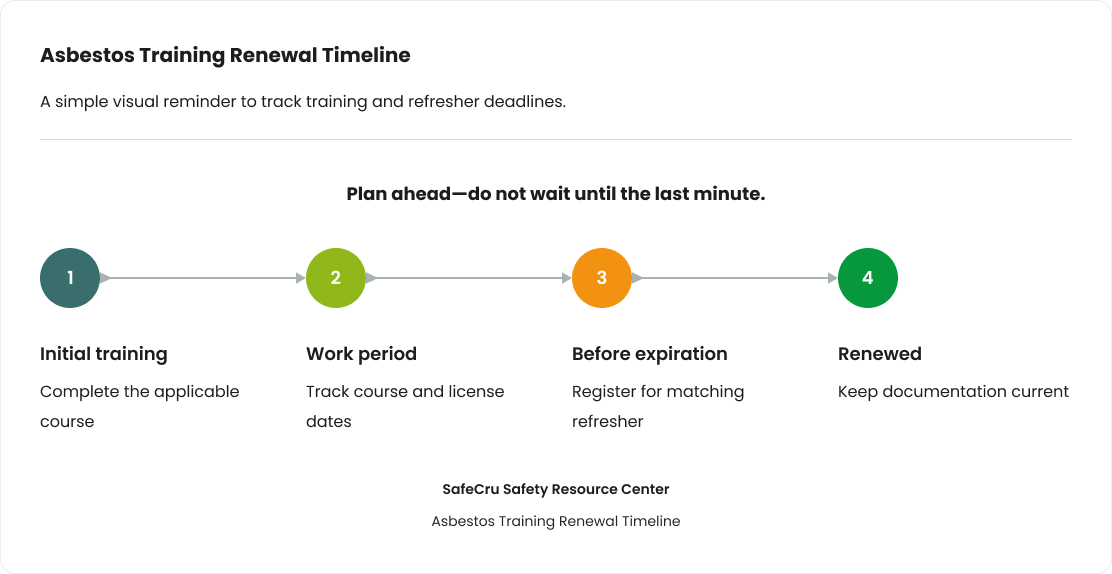
What's the Real Cost of Asbestos Certification Training?
When people ask how much asbestos certification costs, they're usually thinking about tuition. For contractors and employers, though, the actual cost extends well beyond the registration fee.
Direct training costs are straightforward:
Course
Typical Cost
Awareness
$100
O&M Initial
$400
Worker Initial
$625
Supervisor Initial
$750
Course
Awareness
Course
O&M Initial
Course
Worker Initial
Course
Supervisor Initial
These generally cover classroom instruction and materials, but not travel, lodging, meals, or state exam fees.
Indirect costs are where employers often get caught off guard:
- Employee wages — workers are typically paid while attending training. Four employees in a multi-day Worker Initial course means several days of payroll before they're back in the field.
- Travel — mileage, airfare, or rental vehicles depending on where training is held.
- Lodging and meals — multi-day courses often require overnight stays, and some companies cover meal reimbursement.
- Lost production — workers in training aren't generating billable revenue; this opportunity cost is often higher than the tuition itself.
- Annual refresher training — certification isn't a one-time expense. Most regulated certifications require yearly renewal, so budget for it as a recurring cost.
Is Asbestos Certification Worth the Cost?
For nearly every contractor performing regulated asbestos work, yes. Certification protects employees, building occupants, clients, company reputation, and insurance relationships — and it's often a prerequisite for bidding projects that require certified personnel. A single compliance violation or project shutdown can easily cost far more than training an employee correctly the first time.
What Should Employers Verify Before Assigning Workers to Asbestos Work?
Before assigning employees to asbestos work, confirm:
- Current certification
- Annual refresher completed
- Medical surveillance (when applicable)
- Respirator fit testing
- Required PPE
- State documentation
- Project-specific requirements
Keeping this documentation organized simplifies audits, reduces project delays, and signals professionalism to clients.
What Questions Should Contractors Ask Before Hiring an Asbestos Crew?
Whether hiring directly or partnering with a staffing company, a few questions reduce risk significantly:
- Are workers properly certified? Ask for documentation, not just verbal confirmation.
- Are certifications current? An expired certification can mean workers aren't legally permitted to perform regulated activities.
- Who supervises the project? Every regulated project needs qualified on-site supervision
- Are workers covered by workers' compensation? This is often overlooked. Properly classified W-2 employees covered by workers' comp reduce legal and financial risk compared to improperly classified labor.
- Does the company understand asbestos regulations? Experience matters — companies specializing in asbestos work understand containment, documentation, and regulatory expectations that general labor providers often don't.
How Do I Choose the Right Asbestos Training Provider
Not every provider offers the same experience. Before registering, consider:
Accreditation
verify the provider offers EPA-recognized training that meets Indiana's requirements.
Instructor experience
look for instructors with real-world field experience, not just classroom knowledge.
Student support
will they answer questions after class, explain certification pathways, and help guide employers through compliance questions?
Reputation
read reviews and ask other contractors. Providers with strong reputations tend to become long-term educational partners rather than one-time vendors.
What Career Opportunities and Salary Can I Expect After Asbestos Certification?
Demand for qualified asbestos professionals remains steady across commercial renovation, industrial shutdowns, schools, universities, hospitals, manufacturing, government and military facilities, and infrastructure projects.
Nationally, the U.S. Bureau of Labor Statistics reports a median annual wage of $48,490 ($23.31/hour) for hazardous materials removal workers as of May 2024, with the occupation projected to grow about 1% from 2024–2034 — slower than the average for all occupations, but a steady, established field. Indiana-specific labor market data puts the average annual salary for hazardous materials removal workers in the state at roughly $53,726, somewhat above the national median. Actual pay varies by experience, certification level, employer, and project type — supervisors and experienced technicians typically earn more than entry-level workers holding only Awareness or O&M certification.
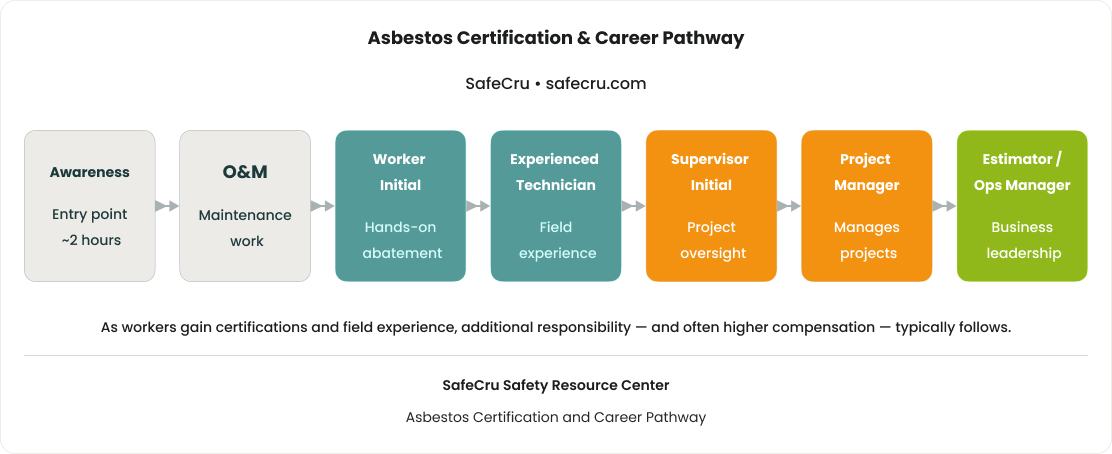
A typical career path looks like: Awareness → O&M → Worker Initial → Experienced Technician → Supervisor → Project Manager → Estimator/Operations Manager. As workers gain certifications and field experience, additional responsibility — and often higher compensation — tends to follow.
Wage and outlook data: U.S. Bureau of Labor Statistics, Occupational Outlook Handbook, "Hazardous Materials Removal Workers" (2024 data, published 2025); Indiana Department of Workforce Development labor market data. Figures are estimates and will change over time — verify current data before using it for compensation planning.
Common Myths About Asbestos Certification
"I only need OSHA training." False — OSHA requirements and asbestos certification requirements serve different purposes and don't substitute for one another.
"Awareness training lets me remove asbestos." False — Awareness teaches recognition, not regulated removal.
"My certification never expires." False — most regulated certifications require annual refresher training.
"I've done asbestos work for years, so I don't need certification." Experience doesn't replace regulatory requirements.
"Every demolition project requires Worker certification." Not necessarily — requirements depend on whether regulated ACM is present and what work will actually be performed. Always verify projectspecific requirements before work begins.
Why Contractors Choose SafeCru
Training is more than earning a certificate. The best contractors want workers who understand safety, compliance, documentation, and professionalism — and our goal isn't just helping students pass a course; it's helping employers build safer, more knowledgeable crews while helping workers build careers they're proud of. Education should prepare people for the real challenges they'll face in the field, not just help them pass an exam.
When contractors invest in quality training, everyone benefits: workers go home safely, projects stay compliant, clients gain confidence, and companies strengthen their reputation. That's why many employers treat training as an investment rather than an expense.
What Students Say
- SafeCru made getting my OSHA certification easy and stress-free. The bilingual instructor explained everything clearly, and the process was smooth from registration to completion.
— Luis G. Supervisor, Louisville
- We regularly send our team to SafeCru for OSHA and asbestos training. The process is smooth, and employees always return well-prepared and confident.
Carlos M., Safety Manager, EnviroPro
Related Resources
- Indiana Asbestos Regulations & Compliance Guide — OSHA, EPA, IDEM requirements, and violation penalties
Final Thoughts
Choosing the correct asbestos certification is about far more than meeting a regulatory requirement. The right training protects workers, keeps projects compliant, improves professionalism, and helps contractors build a reputation for safety and quality.
Whether you're an individual starting your career or an employer responsible for an entire workforce, investing in proper asbestos training is one of the most important decisions you can make. The least expensive course isn't always the correct one — selecting the wrong certification can ultimately cost far more than the price of training itself.
When in doubt, speak with an experienced training provider before registering. Understanding your responsibilities now can prevent costly mistakes later.
About SafeCru
SafeCru provides EPA-accredited asbestos training and continuing education designed to prepare workers, supervisors, and employers for real-world projects — not just the classroom. Our mission is to help construction professionals build safer jobsites, stay compliant with federal and state regulations, and develop long-term careers in the environmental and construction industries.
Whether you're training one employee or an entire workforce, we're here to help you choose the right certification the first time. Browse our asbestos courses or contact us with questions about your specific project.
Sources & Regulatory References
- EPA, Asbestos Hazard Emergency Response Act (AHERA) accreditation requirements, 40 CFR Part 763
- EPA, Asbestos NESHAP, 40 CFR Part 61, Subpart M
- IDEM, Asbestos Program: Laws and Rules — 326 IAC 18, 326 IAC 14-10
- Indiana Code 13-17-6-12, Necessity of License or Accreditation Before Performing Asbestos Project
- U.S. Bureau of Labor Statistics, Occupational Outlook Handbook — Hazardous Materials Removal Workers
This guide is for general informational purposes and does not constitute legal advice. Regulations change — always verify current requirements directly with OSHA, EPA, and IDEM before beginning regulated asbestos work.
Frequently Asked Questions
How much does asbestos certification cost in Indiana?
Costs typically range from $100 for Awareness training to approximately $750 for Supervisor Initial certification. Annual refresher courses generally run $245–$350, depending on the certification type.
Which asbestos certification do I need?
It depends on your job responsibilities: Awareness for workers who may encounter but won’t disturb asbestos, O&M for maintenance staff performing limited work that may disturb it, Worker Initial for regulated removal, and Supervisor Initial for project oversight.
How long does asbestos certification take?
Awareness runs about 2 hours, O&M Initial is typically 1 day, and both Worker Initial and Supervisor Initial are multi-day courses.
Does asbestos certification expire?
Yes. Most regulated certifications require annual refresher training to stay current. Employers should track expiration dates to maintain compliance.
Is OSHA asbestos training the same as asbestos certification?
No. OSHA sets worker safety regulations, while EPA-accredited training and Indiana’s IDEM requirements determine certification qualifications. Completing OSHA training alone doesn’t satisfy certification requirements.
Do I need to pass an Indiana state exam?
Depending on your certification category, Indiana requires meeting IDEM licensing and examination requirements in addition to accredited training. Always verify current IDEM requirements before beginning regulated work.
Can I take asbestos certification online?
Some Awareness courses may be offered online. Worker, O&M, and Supervisor training typically include classroom and hands-on components required by regulation.
Can my employer pay for my training?
Yes — many employers cover asbestos certification costs, since properly trained employees reduce regulatory risk and improve workplace safety.
What size project requires asbestos notification under NESHAP?
Generally, projects disturbing at least 260 linear feet on pipes, 160 square feet on other components, or 35 cubic feet where length or area can’t be measured. Indiana’s own notification rules should also be checked, since state requirements can apply even below federal thresholds.
How often should employers retrain workers?
Most regulated certifications require annual refresher training. Employers should maintain a training calendar to avoid lapses.
Does every construction worker need asbestos certification?
No — it depends on job duties. Many construction workers only need Awareness training, while those performing regulated asbestos work need Worker or Supervisor certification.
What happens if my certification expires?
You may be unable to legally perform regulated asbestos work until you complete the required refresher training. Expired certifications can also delay projects and create compliance issues for employers.
What industries require asbestos-certified workers?
Commercial construction, industrial maintenance, environmental remediation, healthcare, education, manufacturing, government, infrastructure, demolition, and facility maintenance
Does my out-of-state asbestos certification transfer to Indiana?
No — Indiana doesn’t offer blanket reciprocity. You’ll need to meet IDEM’s licensing requirements directly, including passing Indiana’s written exam, even if you’re already certified in another state.
How much do asbestos-certified workers earn in Indiana?
The national median for hazardous materials removal workers was $48,490/year as of May 2024 (BLS), with Indiana-specific data putting the state average around $53,726/year. Pay varies by certification level, experience, and employer.