This is the single most-asked question across OSHA training research — and for good reason, since the two courses are easy to confuse but serve genuinely different purposes. Here's a full breakdown.
Ir a:
The Core Difference
| OSHA 10 | OSHA 30 | |
|---|---|---|
| Longitud | 10 hours | 30 hours (3.5 days) |
| Precio | $350 | $600 |
| Typical audience | Entry level workers, laborers, new hires | Supervisors, foremen, safety managers |
| Content depth | Foundational hazard awareness | Broader safety management responsibility |
| Requisitos previos | Ninguno | Ninguno |
Both are part of OSHA's Outreach Training Program and result in an official Department of Labor completion card. The difference is depth and audience, not one being a "better" or more official version of the other.
What OSHA 10 Actually Covers
OSHA 10 introduces the most common and serious workplace hazards, workers' rights, employer responsibilities, and the OSHA complaint process. It's designed as a starting point — enough foundational knowledge for a worker to recognize hazards and understand basic safety expectations on a construction site.
What OSHA 30 Actually Covers
OSHA 30 covers the same hazard categories in significantly more depth, plus material specific to supervisory responsibility: safety program management, broader regulatory awareness, and the kind of oversight expected of someone responsible for other workers' safety, not just their own.
Common Misconceptions
- "OSHA 30 replaces OSHA 10." No. They're not sequential levels of the same credential. OSHA 30 doesn't require or include OSHA 10, and a supervisor can hold OSHA 30 without ever separately completing OSHA 10.
- "I need both to be fully compliant." Not necessarily. Which one, or whether you need both, depends on your role and what your employer or job site specifically requires. There is no universal rule requiring both.
- "OSHA 30 is just a longer version of OSHA 10." Not quite. While OSHA 30 covers overlapping hazard categories in more depth, its content is specifically built around supervisory and safety management responsibility, not simply more hours of the same material.
Which One Do You Actually Need?
- You're new to construction, working as a laborer or entry level tradesperson → OSHA 10
- You supervise other workers, manage a site, or are responsible for safety oversight → OSHA 30
- You're not sure which your employer or job site requires → Check directly before enrolling, since site specific requirements vary.
Career and Pay Considerations
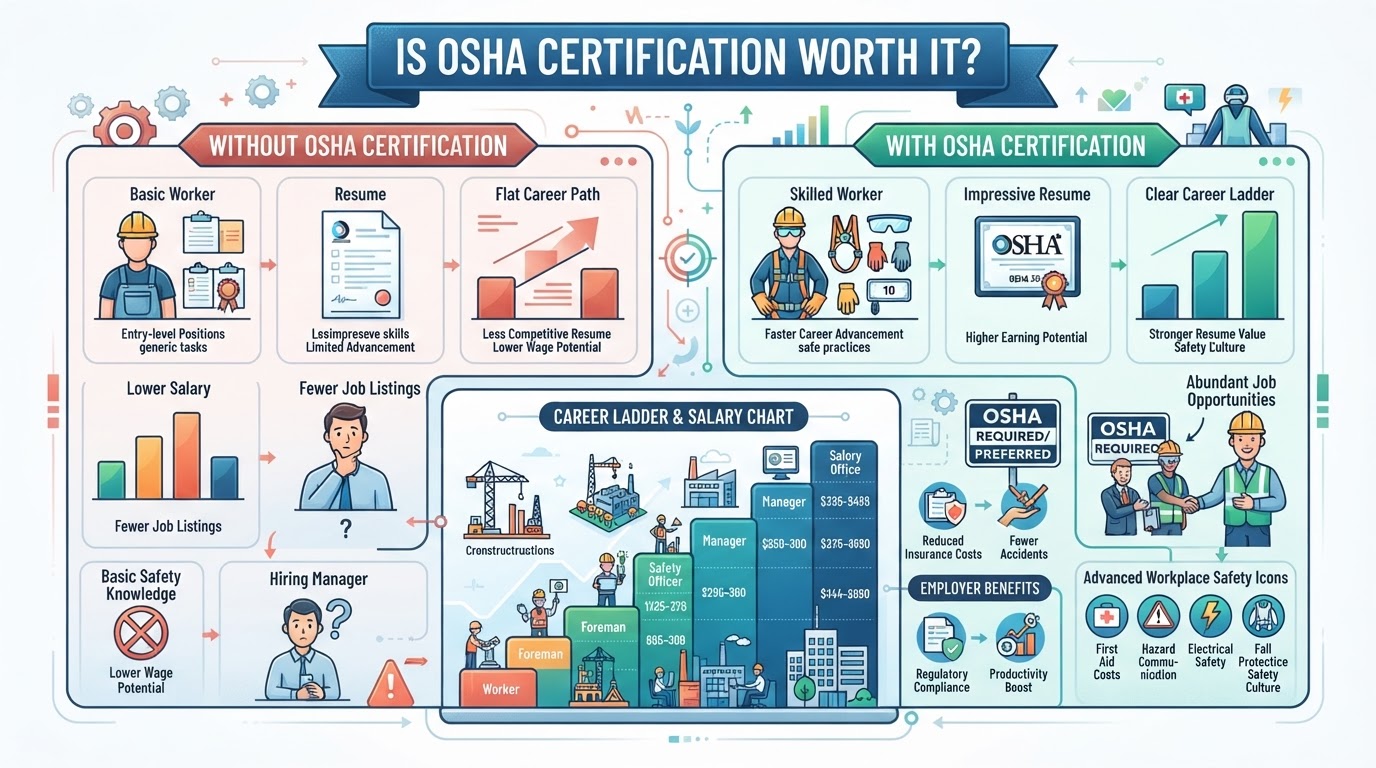
OSHA 30 tends to matter more for career advancement specifically because it's tied to supervisory eligibility — many foreman, supervisor, or safety-lead roles require it directly. OSHA 10, meanwhile, is more often a baseline job-site entry requirement than a differentiator for advancement.
For a full breakdown of career and pay impact, see ¿Vale la pena la certificación OSHA? Valor profesional y salarial explicado.
Time and Cost Comparison
| OSHA 10 | OSHA 30 | |
|---|---|---|
| Time investment | 10 hours (often 1 to 2 days) | 30 hours (3.5 days) |
| Costo | $350 | $600 |
| Best for | Entry level roles, quick baseline certification | Supervisory roles, longer term career investment |
If you're weighing which to prioritize and your role doesn't clearly require one over the other, OSHA 10 is the lower-cost, lower-time-commitment starting point — OSHA 30 is worth the larger investment specifically when a supervisory role is the goal.
For the full course breakdown, see Guía completa de SafeCru sobre la capacitación de OSHA.
Preguntas frecuentes
Do I need OSHA 10 before I can take OSHA 30?
No — neither course has a prerequisite. You can enroll directly in OSHA 30 without first completing OSHA 10.
Is OSHA 30 harder than OSHA 10?
It covers more material in more depth and requires a larger time commitment (30 hours vs. 10), but neither course is designed as a difficult “gatekeeping” exam — both are built around completing the required instruction.
Which one is required for construction site supervisors?
OSHA 30 is more commonly required for supervisory roles; OSHA 10 is more commonly the baseline requirement for general workers.
Can I take both OSHA 10 and OSHA 30?
Yes — some workers complete both over the course of their career as their role evolves, though it’s not a formal requirement to hold both.
Is OSHA 30 available bilingually like OSHA 10?
Yes — SafeCru offers both courses in English and Spanish.