The Complete Guide to OSHA Training
OSHA 10, OSHA 30, and Construction Safety Certification in Indianapolis
If you work in construction — or you’re hiring, supervising, or managing a crew that does — OSHA training is likely something you’ve been told you need, without always being told exactly why, which level applies to you, or what it actually involves. This guide covers what OSHA training is, the real difference between OSHA 10 and OSHA 30, what each course costs and requires, and what to expect from SafeCru’s bilingual, Indianapolis-based training.
Saltar a
What Is OSHA TrainingOSHA 10 vs. OSHA 30Which Do You NeedCost & Course DetailsIs It Worth ItDifficulty & Exam Format
Datos rápidos
| OSHA Training Quick Facts | |
|---|---|
| Courses offered | OSHA 10, OSHA 30, OSHA 10 + Scaffold User combo |
| Idioma | English & Spanish |
| Ubicación | Indianápolis, IN |
| Format | In-person, instructor-led |
| Weekend Classes | Available on request |
| Requisitos previos | None for OSHA 10 or OSHA 30 |
| Certification Validity | No federal expiration — often treated as good for 3-5 years by employers/states |
What Is OSHA Training?
OSHA — the Occupational Safety and Health Administration — is the federal agency responsible for workplace safety regulation in the United States, established in 1970. OSHA 10 and OSHA 30 aren’t certifications issued directly by OSHA; they’re part of the Programa de Capacitación de Alcance de OSHA, delivered by authorized trainers like SafeCru, and result in an official completion card issued by the U.S. Department of Labor (DOL).
¿Sabías que...?
OSHA doesn’t require every worker to complete OSHA 10 or OSHA 30 — the courses aren’t federally mandated in most cases. They’re commonly required by employers, general contractors, unions, or state and local laws, even though OSHA itself doesn’t issue a blanket federal requirement for most industries.
Why OSHA Training Exists
The Outreach Training Program is designed to educate workers about the most common and serious workplace hazards, workers’ rights, employer responsibilities, and how to file an OSHA complaint. It’s foundational safety education — the goal is prevention, not just compliance paperwork.
OSHA itself was created in 1970 under the Occupational Safety and Health Act, with a mission to ensure safe and healthy working conditions by setting and enforcing standards, and by providing training, outreach, education, and assistance. Construction remains one of the industries with the highest rates of serious workplace injury, which is part of why OSHA 10 and OSHA 30 are so commonly required — even without a blanket federal mandate — by general contractors, project owners, insurers, and local governments.
Who Actually Requires OSHA Training?
There’s no single federal law that says “every construction worker must have OSHA 10.” Instead, the requirement usually comes from one of these sources:
General contractors and project owners
many require proof of OSHA 10 (or OSHA 30 for supervisory roles) before allowing workers on a job site, as a condition of the contract
State and local governments
some states and cities have their own laws requiring OSHA training for construction work; New York City’s Local Law 196 is one of the best-known examples, requiring OSHA 10 or 30 training as part of its Site Safety Training (SST) program
Unions and trade associations
many require OSHA training as part of apprenticeship or membership requirements
Insurance carriers
some general liability or workers’ comp policies factor in whether a workforce is OSHA-trained
Because the requirement is layered rather than singular, the honest answer to “do I need OSHA training” is almost always “check with whoever is requiring you to be on the job site” — but in practice, having OSHA 10 at minimum is close to a universal baseline expectation in construction.
Common OSHA Violations
Some of the most frequently cited OSHA violations in construction include:
- Fall protection failures — consistently OSHA’s most-cited violation category in construction, covering missing guardrails, harnesses, and fall arrest systems
- Hazard communication gaps — not properly labeling or training workers on hazardous chemicals present on site
- Scaffolding violations — improper construction, missing guardrails, or inadequate access
- Ladder misuse — using the wrong ladder for the task or improper setup
- Respiratory protection issues — missing or improperly fitted respirators where required
- Lockout/tagout failures — not properly de-energizing equipment before maintenance
OSHA training directly addresses hazard recognition for these categories, which is exactly why “significant workplace dangers” sits at the center of the Outreach curriculum — the goal is that workers recognize these hazards before they cause an injury, not just after an inspector cites them.
OSHA 10 vs. OSHA 30: What’s the Real Difference?
| OSHA 10 | OSHA 30 | |
|---|---|---|
| Longitud | 10 hours | 30 hours (3.5 days) |
| Typical audience | Entry-level construction workers | Supervisors, foremen, safety managers |
| Content depth | Foundational hazard awareness | Broader safety management responsibility |
| Requisitos previos | Ninguno | Ninguno |
| Do I need both? | Not required — many workers only ever complete OSHA 10 | Not required to have OSHA 10 first |
A common misconception: OSHA 30 does not “replace” or “include” OSHA 10. They’re not sequential levels of the same credential — they’re two different-depth courses aimed at two different roles. A supervisor might reasonably hold only OSHA 30 without ever completing OSHA 10 separately, and an entry-level worker doesn’t need OSHA 30 just because they already have OSHA 10.
For a deeper breakdown, including career and pay considerations, see OSHA 10 vs. OSHA 30: ¿Cuál necesitas?
Which OSHA Course Do You Need?
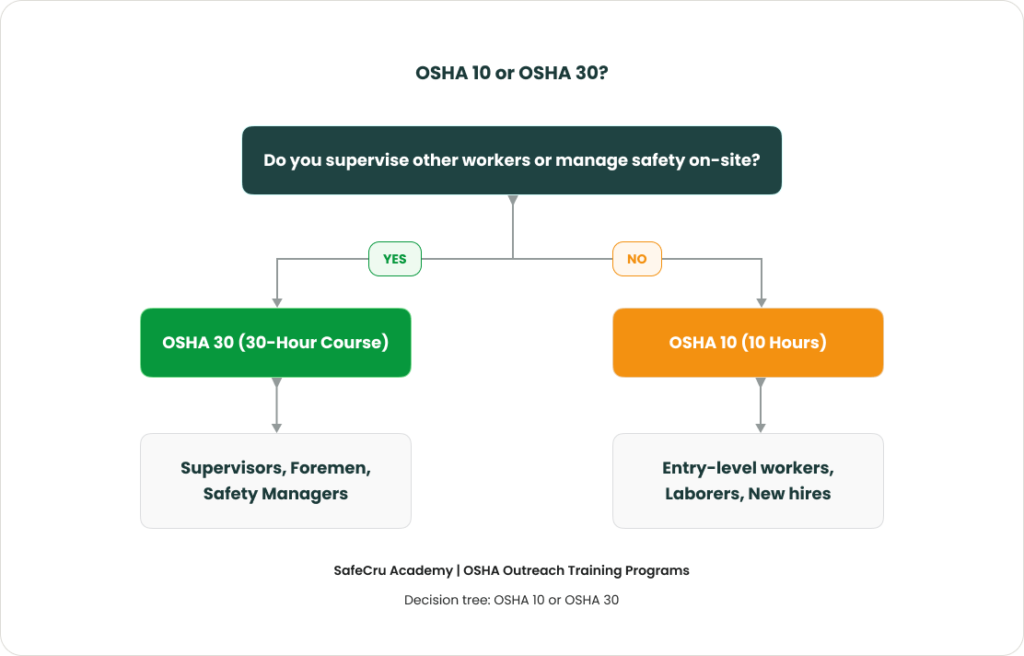
Entry-level construction workers, laborers, new hires
OSHA 10Supervisors, foremen, project managers, safety leads
OSHA 30Workers who also need Scaffold User certification
OSHA 10 + Scaffold User comboIf you’re not sure which applies to your role, check with your employer or general contractor first — many job sites specify which level they require before work can begin.
SafeCru’s OSHA Course Catalog
| Curso | Precio | Longitud |
|---|---|---|
| OSHA 10 | $350 | 10 hours |
| OSHA 30 | $600 | 30 hours (3.5 days) |
| OSHA 10 in Construction + Scaffold User 8hr | $350 | 2 days (10 hours total) |
OSHA 10 pricing includes all training materials and your official DOL completion card. All SafeCru OSHA courses are taught in person in Indianapolis, available bilingually in English and Spanish, and weekend scheduling is available — reach out if a weekend session isn’t currently on the calendar.
What OSHA 10 Covers
OSHA 10 provides fundamental safety and health knowledge for individuals starting their careers in construction and general industry — an entry point into the Outreach Training Program. The curriculum introduces significant workplace dangers, workers’ rights, employer responsibilities, and the OSHA complaint process, giving new workers a foundational understanding of how to recognize and avoid the most common jobsite hazards.
What OSHA 30 Covers
OSHA 30 is built for construction site supervisors, superintendents, and project managers — anyone with responsibility for other workers’ safety, not just their own. It covers the same hazard categories as OSHA 10 in significantly more depth, plus additional material on safety program management, incident prevention responsibilities, and the broader regulatory landscape supervisors are expected to navigate.
The OSHA 10 + Scaffold User Combo
This course bundles two certifications into one 3-day session: OSHA 10 in Construction, plus Scaffold User certification — useful for workers whose jobs involve both general construction safety requirements and scaffold work specifically. Getting both in a single course avoids the scheduling overhead of enrolling in two separate trainings.
SafeCru does not currently offer online OSHA training. For more on why in-person instruction is the SafeCru approach, see In-Person OSHA Training: Why SafeCru Teaches It This Way.
Is OSHA Certification Worth It?
This is one of the most frequently asked questions about OSHA training — worth answering directly. For most construction workers, yes: OSHA 10 is
often a baseline requirement just to get on a job site, and OSHA 30 frequently opens doors to supervisory roles that OSHA 10 alone doesn’t. Beyond the
credential itself, both courses cover hazard recognition that directly reduces on-the-job injury risk — a real, practical benefit independent of whatever a
resume or paycheck shows.
For a full breakdown of career impact, resume value, and pay considerations, see Is OSHA Certification Worth It? Career & Pay Value Explained.
How Hard Is the OSHA Exam?
Neither OSHA 10 nor OSHA 30 is designed to be a difficult “gatekeeping” exam — the Outreach Training Program is built around completing all required hours of instruction, not passing a high-stakes test. That said, some quizzes or knowledge checks are typically part of the course to confirm understanding of the material.
[Confirm before publishing: does SafeCru’s OSHA 10/30 course include a formal final exam or quiz, and if so, what happens if a student doesn’t pass? This affects the accuracy of the difficulty/exam-format section.]
Does OSHA Certification Expire?
This is more nuanced than a simple yes or no:
How Long Does OSHA Certification Actually Last?
Federal Rule: Never Expires
No official OSHA renewal requirement at the federal level
Practical Reality: Often Required Every 3-5 Years
Employers, states, and cities (e.g. NYC, Philadelphia) often require it
Federal rule: OSHA certification never expires, versus practical reality: often required every 3-5 years
- At the federal level, OSHA 10 and OSHA 30 cards do not expire. Once issued, they remain valid indefinitely — there’s no official OSHAmandated renewal requirement
- In practice, many employers, unions, and local jurisdictions require training completed within the last 3-5 years. For example, New York City’s Local Law 196 requires OSHA 10/30 training completed within the last 5 years for its Site Safety Training program, and Philadelphia requires licensed contractors to have a supervisor with OSHA 30 completed in the last 5 years.
- Replacement cards have a hard limit: if you lose your card, a replacement can only be issued if your training was completed within the last 5 years, since authorized trainers are only required to retain class records for 5 years.
The practical takeaway: your OSHA card itself never “expires,” but if it’s been more than 5 years, don’t assume it will satisfy every employer or jurisdiction’s requirements — check before relying on older training.
OSHA Recordkeeping: The “7-Day Rule”
This term shows up in searches but isn’t actually about training or certification — it refers to a separate OSHA employer requirement. Under 29 CFR 1904.29(b)(3), employers must record a recordable workplace injury or illness on the OSHA 300 Log within 7 calendar days of receiving notice of it. It’s a recordkeeping compliance rule for employers, not a rule about how long OSHA training takes or how long certification lasts.
Enseñanza bilingüe
SafeCru’s OSHA courses are taught in both English and Spanish. For more, see Capacitación bilingüe de OSHA: Instrucción en inglés y español
Common Myths About OSHA Training
| Myth | Reality |
|---|---|
| “OSHA issues the certification directly.” | OSHA sets the Outreach Training Program requirements; authorized trainers like SafeCru deliver the instruction, and the DOL issues the completion card. |
| “OSHA 30 replaces OSHA 10.” | They’re separate courses for different roles — OSHA 30 doesn’t require or replace OSHA 10. |
| “My OSHA 10 card expires after a set number of years.” | Not federally — but many employers and local laws treat training older than 3- 5 years as outdated |
| “OSHA training is legally required for every construction job.” | It’s not a blanket federal mandate — requirements typically come from employers, contracts, unions, or local law. |
| “Online and in-person OSHA training are the same experience.” | Both can satisfy Outreach requirements, but they differ significantly in format — see In-Person OSHA Training for the details. |
Group & Employer Training
SafeCru supports registering multiple students together under one company contact for OSHA courses — useful for employers certifying a crew at once rather than staggering individual enrollments. This works for a single course or a mix of OSHA 10 and OSHA 30 depending on which roles need which level.
Por qué elegir SafeCru
SafeCru offers OSHA 10, OSHA 30, and a combined OSHA 10 + Scaffold User course, taught in person and bilingually in Indianapolis, with weekend scheduling available on request.
Preguntas frecuentes
What’s the difference between OSHA 10 and OSHA 30?
OSHA 10 is a 10-hour foundational safety course typically for entry-level workers. OSHA 30 is a 30-hour course covering broader safety management content, typically for supervisors and safety leads. Neither is a prerequisite for the other.
How much does OSHA 10 cost?
$350, including training materials and your official DOL completion card.
How much does OSHA 30 cost?
$600
Can I get OSHA certified for free?
SafeCru’s courses are paid training; some employers cover the cost for their employees. There isn’t a free federally-administered version of OSHA 10 or OSHA 30 training.
Does the employer pay for OSHA training?
It varies by employer — many cover the cost as part of onboarding or compliance requirements, but this isn’t a federal requirement.
Is OSHA training available online?
SafeCru does not currently offer online OSHA training — all courses are taught in person in Indianapolis. Some other providers do offer online options.
Does OSHA 10 or OSHA 30 expire?
Not federally — cards are valid indefinitely. However, many employers and jurisdictions require training completed within the last 3-5 years, and replacement cards are only available within 5 years of your original training date.
Is OSHA 10 hard to pass?
The Outreach Training Program is built around completing the required instruction hours rather than passing a high-stakes exam. [Confirm SafeCru’s specific exam/quiz format before publishing.]
Do I need both OSHA 10 and OSHA 30?
No — they’re not sequential requirements. Which one (or both) you need depends on your role and what your employer
or job site requires.
Is OSHA certification worth it?
For most construction workers, yes — it’s frequently a baseline job-site requirement, and OSHA 30 often opens supervisory opportunities. See the full article linked above for career and pay details.
What is the OSHA 7-day rule?
It’s an employer recordkeeping requirement (29 CFR 1904.29(b)(3)) requiring workplace injuries/illnesses to be logged within 7 calendar days of notice — not related to training certification timelines.
Can our company register a group for OSHA training?
Yes — SafeCru supports registering multiple students under one company contact.
Is OSHA training offered in Spanish?
Yes — SafeCru’s OSHA courses are available in both English and Spanish.
Can I schedule a weekend OSHA class?
Yes — reach out if a weekend session isn’t currently on the calendar, and SafeCru will work with you to schedule one.